Showing posts with label Mimi Favre. Show all posts

Wednesday, March 19, 2014

Art Deco Miniature Arrangement Class- Philadelphia Flower Show 2014


This year I made an entry to the Philadelphia Flower Show that is not jewelry! Instead, as I wrestled with my disappointment at being ‘too late’ for the already filled jewelry class, my good friend who is also a competitor, suggested that I enter the Mini-Arrangement Niche class titled ‘Art Deco’. The parameters are to use dried plant material, same as the Artistic Jewelry classes, however it is permissible to also use other non-plant materials. The entry must not exceed five inches in any direction. And, the box is to be lined in mat board color of choice. 
Philadelphia Flower Show- Mini Niche Art Deco, 2014. M Favre©
The only directive to the artist is the title, Art Deco. Though interpretation of the title is important, so are other considerations such as craftsmanship, design, scale and imaginative use of the material. The niche is a lighted box that is staged at eye level to the viewer. As a newbie, I struggled with what sort of object to make as well as how to install it. Flower Show entries always take a lot of time to make—time away from real jewelry making which is my business. I approach each entry as a creative exercise that will re-boot and refresh my design process. It’s great to get a blue ribbon (recognition clipped above your entry for the duration and an invitation to the PHS Luncheon) or even a second or third. This was not a blue ribbon year! Our class of four entries was Commended-- that means all entries had with high high point values and were worthy of ribbons.  

           Art Deco is a period of design from about 1920-1930 that was influenced by modern architecture, King Tut's Tomb and the modern machine age. I began by looking at a lot of images to glean the essence of particular elements that convey the style. My friend gave me a mini-box, built to exact dimensions of the show to use. It’s helpful when you are trying to fill a defined space to see how your object relates to the space. 
Tools of the Artistic Class- work table.MFavre©

      The challenging part for me was manipulating elements into space. I begin by laying out ideas and taking pictures with my phone. This results in two-dimensional designs that still need to have some depth. Until you start attaching and gluing it’s hard to see what is and is not working. And, being able to block out of your head what colors to use, really seeing the forms is more important. 

      Often while I was making my piece I was thinking of the extraordinary small windows of Tiffany in New York City by the lengendery Gene Moore and the effort he made to place the jewelry amongst other elements--all in perfect scale. I know now that I should have been more conscious of the surrounding negative space.


Design progression. Art Deco Mini-Arrangement. Philadelphia Flower Show 2014. M Favre©


This entry took too long this time! I felt a little blocked and just was not seeing a design I liked. It happens. Looking at the designs--I could have done #1 and it would have been OK. I got some things right with the final design but it's good to critique the project.
In retrospect I wasted time on some things:
1. Over thinking. This project reinforces the importance of knowing when and what to edit. 
2. I got stuck on a design for too long--a design I abandoned at the last minute.
3. I got too caught up on determining my Art Deco color palette which includes the color of mat board—I kept switching out between four different mat board colors. I used teal.(I took pictures of my palettes which do make nice wallpaper for my phone!) 

            For some reason I limited my design to maxing out the 5” space and did not see that it was out of scale. It was too big for the space. (Pointed out by the judges!)
Art Deco color palettes. Black mat, teal mat, mango mat, yellow mat. M Favre©


This is my Art Deco entry made from dried plant material. Made with hickory, acorn, leaves, deciduous azalea pod, verbena stem, holly berry, gourd. Gold, Magenta, Silver, Blue.

Art Deco- Miniature Arrangement, Philadelphia Flower Show 2014. MFavre©
Commended Class. Honorable Mention.
The following are the three other entries.
Art Deco Blue Ribbon, by Hollis Bauer.

Art Deco Second Place.

Art Deco Third place.


Sunday, November 24, 2013

Franklinia Seed Pod Pendant


Franklinia alatamaha. Photo by Mimi Favre
Franklinia alatamaha is an extinct tree species that was once native to Georgia. It was named after Benjamin Franklin by William Bartram, son of colonial era naturalist nurseryman John Bartram, of Philadelphia, Pennsylvania. The Bartrams were the first commercial plant nursery in the colonies and are responsible for sending thousands of native plant species from the colonies to Great Britain.

Their home was once part of a 1,000 acre tract of land along the Schuylkill River south of center city Philadelphia. The site was originally settled in 1648 however excavated archeological finds indicate that this land was also home to native Indians 3000 years ago. Born to a Quaker family, John Bartram spent his life learning about science and botany with boundless curiosity. Bartram’s Garden is open to visitors throughout the year.
Bartram's Garden Program: Twilight in the Garden- Fundraiser 2013. Bartram's Garden©
'Twilight in the Garden' is the annual fall fundraising benefit for Bartram’s Garden. This year, a friend on the event committee asked if I could create a pendant from a Franklinia seed pod that she had collected a few years back from the grounds at Bartram’s Garden. The seed pod is from a living, flowering franklinia alatamaha that been thriving at the garden.

Sometimes, jewelry projects find their way to me and this was a project I was eager to help with. Even though her one and only rare seed pod, would have to be destroyed in the process, she was excited that it would become a pendant to be offered as a Raffle item at the Twilight fundraiser.
Franklinia seed pod. 

Franklinia seed.

Franklinia seed pods. M Favre©.
The mature seed pod has a magnificent structure. Once round, it expands as it dries into  five sections that split, allowing the seed to release. The tip of the seed has a five pointed shape. Unable to mold the entire pod, I decided to cast it. That is, burn it out and fill the void with metal. But thinking ahead, that maybe we would want to make others in the future, I decided to cut the original casting in half. That way we could mold the halves and put it back together later. Also, there was a seed in the middle that had come loose from the outer shell. I gently pulled it through. That piece was also molded. 
Franklinia pod. Two halves. Mimi Favre©
Three pieces, once cast, were re-assembled (soldered together). The sterling silver casting was hand finished to retain all of the interesting textures and the center seed is still loose and free to move.
Sterling Franklinia seed pod. Mimi Favre©

Franklinia Seed Pod. Sterling silver ©Mimi Favre.


Much has been written about John Bartram and his legacy as naturalist, botanist and nurseryman. I recommend this recent book: The Brother Gardeners, Botany Empire And The Birth Of An Obsession,  by Andrea Wulf. Knopf 2010. 


Friday, August 2, 2013

Vacation- France and le Tour


Tours, France. Stage 13, Tour de France 2013. Photo M. Favre©
I've owned several road bikes over the years. I rode thousands of miles and participated in amateur racing (all--in my youth). I had stopped riding until recently. I bought a new Pinarello road bike to get back into cycling. In recent years I have enjoyed watching the Tour de France which has been broadcast live each year for the duration- twenty one consecutive mornings. Despite the doping accusations that have plagued cycling and the resulting downfall of Lance Armstrong, I haven't lost interest. Cycling is a great sport and this is probably the hardest athletic event in the world. The backdrop of the French landscape, countryside and mountains, figures prominently into this spectacle which just finished for the one hundredth time on July 21 in grand style, in Paris. This year the riders rode 3,404 kilometers.

Some very good friends, who happen to be BIG fans of the Tour de France, invited me to join them on a motoring trip following the riders and route of the 2013 Tour. I met up midway through their itinerary in Tours, France in time to see the finish of Stage 12.


The morning of Stage 13, Tours to Saint-Amand-Montrond, the Bicycling magazine crew was having a breakfast strategy meeting in the small dining area of our hotel! Our strategy for the day was to catch some swag from the Caravan and walk around the pre-race staging area in Tours where each team's bus, bikes and support vehicles were on display. I took a lot of pictures of bikes but my favorite shot that day was of a rider who stopped to give young fans his autograph. Later we watched the slow roll out of the start of the stage.


Team Saxo-Tinkoff bikes. #91- Alberto Contador.  Photo by M. Favre©
Team Cannondale bikes. #11 Peter Sagan- Winner of Green Jersey.
Photo M. Favre©
Extra Pinarello Dogma bikes. Team SKY. Photo M. Favre©
Lampre- Merida rider #148 Niemiec Przemyslaw stops pre-race to sign autograph. Photo M. Favre©
On Bastile day, July 14, Stage 14, we parked the car in the field of a vineyard and walked a few kilometers uphill to the Col de Madeleine where we picnicked as we waited for the riders. It is about 28 kilometers from the finish on Mount Ventoux. 


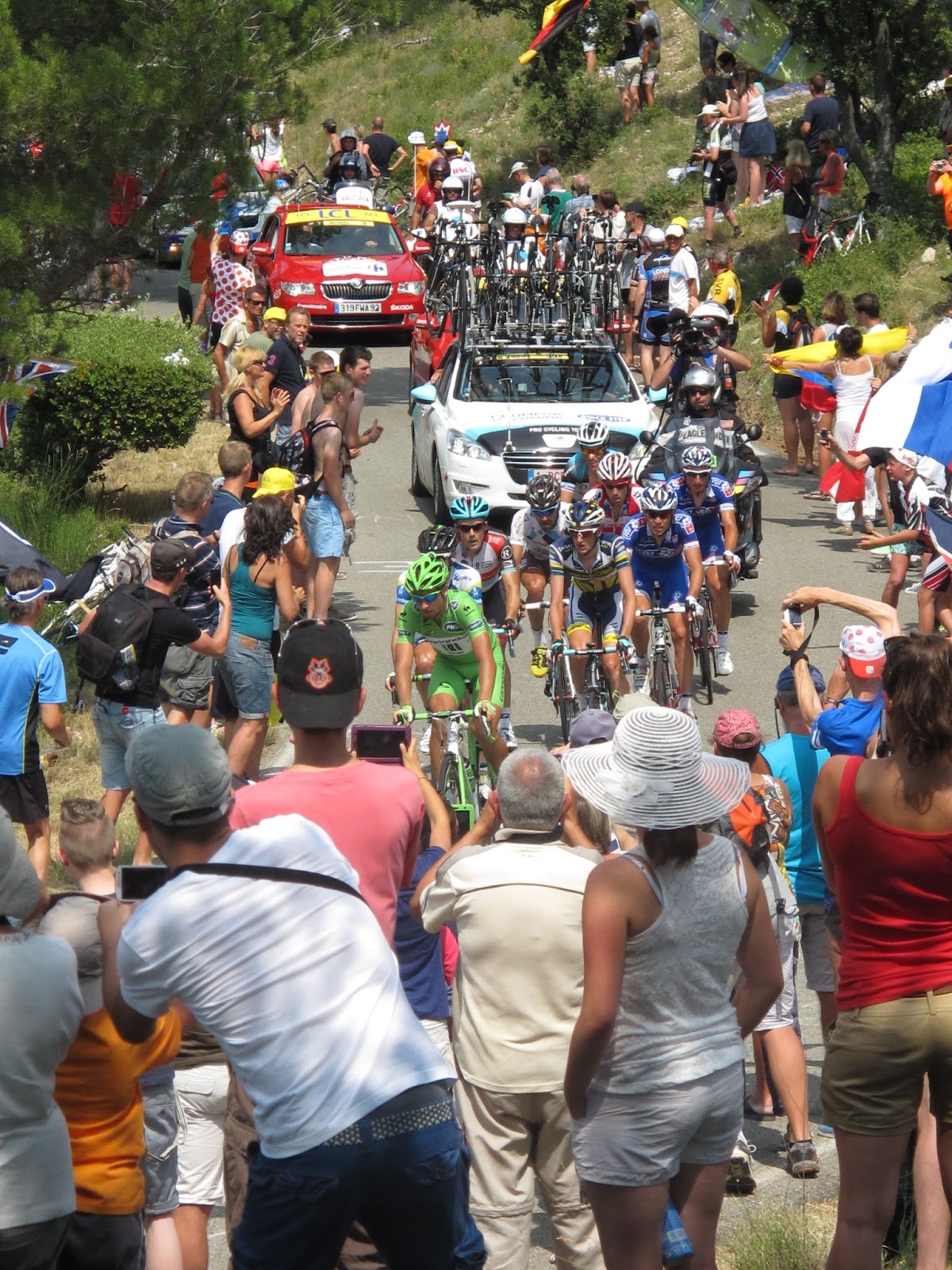
Stage 14, Tour de France 2013. Photo M. Favre©
Peter Sagan leads Stage 14 on Col de Madeleine. Photo M. Favre©
After the racers sped by, we were able to watch the finish on a computer in the woods, powered by a car battery and a satellite dish! We met fans from Australia, New Zealand and the US. 
Watching TV broadcast of the finish on Col de Madeleine (28k up Mount Ventoux)
on battery powered computer via dish! Vive le Tour!
Photo M. Favre©
Aside from the race, there was time to enjoy the French countryside and culture. In Lyon we sampled local cheese and fruit.

Market Day in Lyon, France. Photo M. Favre©

We stayed at an amazing Chateau in Rosans. Our host, Marcel van der Hulst was incredible.
Old Postcard of Chateau Rosans.
Chateau Rosans, 2013. Photo M.Favre©
Breakfast at Chateau Rosans. Photo M. Favre©
We took the TGV back to Paris in time to spend a few days and see the finish. 
Caravan of le Tour de France 2013 enters the Louvre. Photo M. Favre©


Riders enter on Pont de Carrousel, Paris. As a spectator you hear the helicopters in the distance while you wait. Then the lead out Grenardiers on motorcyles  plus a few Official cars come speeding by. Suddenly, the riders pop into view for seconds as they fly by. (Video) Listen for the sound of the crowd clapping and cheering as the riders enter the bridge. On the ground is way different from seeing the Helicopter footage!!

Match the bike #'s to riders here, Velo News


Friday, March 1, 2013

Quinevere- Necklace


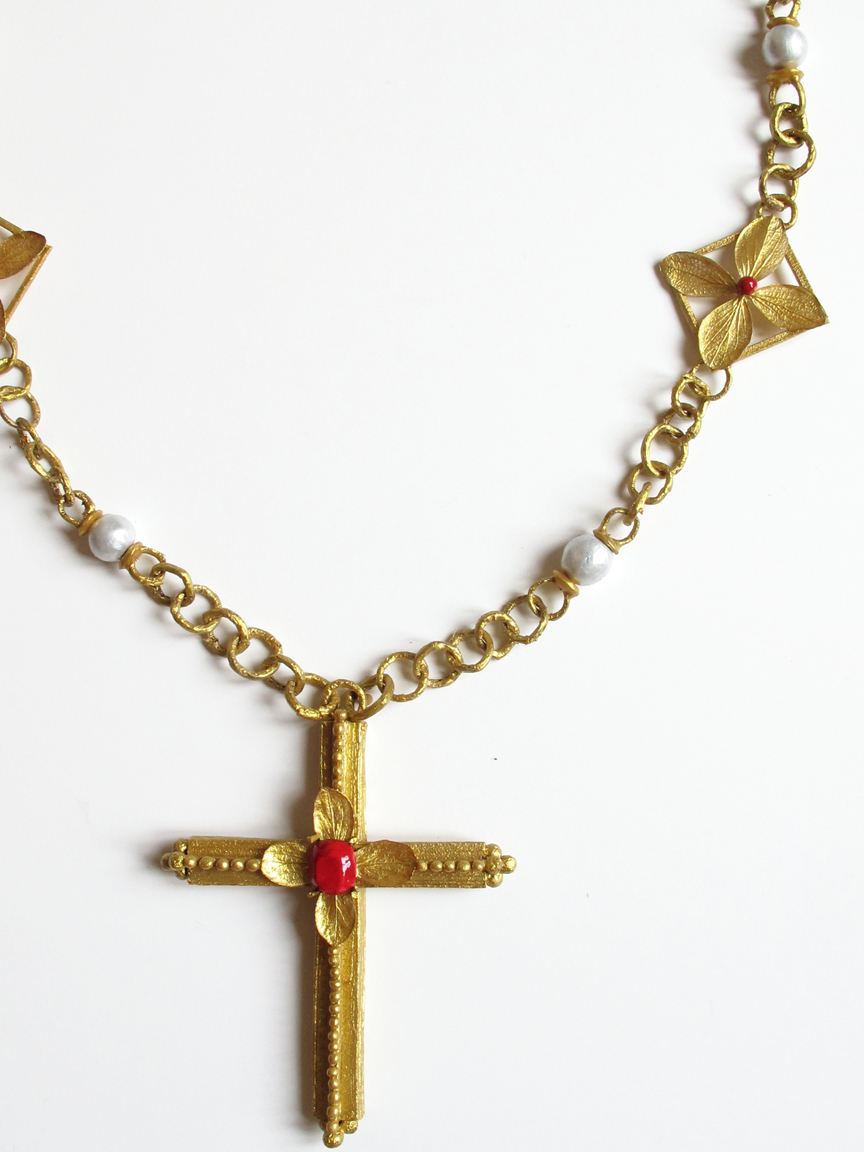
Quinevere Necklace made from dried plant material. Philadelphia Flower Show- by Mimi Favre 2013. 


Again this year I have made a piece of jewelry from dried plant material for the Philadelphia Flower Show. Keeping to the British show theme, "Brilliant", this Artistic Jewelry Class is called, “Quinevere”- Necklace. That is all the direction one is given. The challenge is to interpret the theme (points for that) as well as make a well-crafted piece that ‘looks’ as if it could be worn (lot's of points). Sounds easy, but every time I make one of these pieces I totally underestimate how much time it will take and work to the last possible minute. 

After reading a bit about the legendary Queen, I settled on a period piece that would reflect femininity and her Christian beliefs. A friend saw the components before I finished and said “it looks just like your jewelry!" I really love this piece and would welcome a chance to make it in real gold with a beautiful ruby!

The creative process is a combination of finding interesting organic plant material by shape or texture and thinking of ways it could be used. Collecting is an ongoing process and I do have several boxes of potential seed pods, nuts, leaves, stems, berries, etc. The spice cabinet or pantry aren't off limits either- I used mustard seeds and lentils on this necklace.

I was walking outside one windy day a few weeks ago and picked up a dried cluster of hydrangeas that had blown over from my neighbors house. I had been thinking of making a thick chain and cross and this was the inspiration I needed to flesh out the design. The petals as stations on the chain are a classic form in the decorative arts known as a quatrefoil which was used in the Medieval period. I added the holly berry 'pearls' to visually break the chain and make this a strong yet feminine piece, something a Queen might wear. 
Updated- read how to on PHS Online https://phsonline.org/blog/a-gem-of-a-class-looking-back-at-the-botanical-beauties-of-the-flower-sho
Components. Birch twig links, hydrangea Quatrefoil.
I made the cross, a very linear component, from verbena bonariensis (thank you Wendy). The links are made from green birch twigs, twisted onto chopsticks, left to dry, then cut into jump rings. Each one has to be glued closed. 
Quinevere Necklace- Cross and Quatrefoil.

Quinevere Necklace- verbena stem (squares), birch twig (links), holly berry 'pearls'. Mimi Favre. 2013

I was cleaning up the inevitable mess that I had made, a pile of discarded pieces, trial painted seeds, 'stone' settings not used, extra 'pearls' and thought, well, this picture says it all! I do paint ideas out first even thought the piece evolves organically.
Dried plant materials for Jewelry.

Quinevere Necklace. Hydrangea, beautyberry, verbena stems, holly berry, lentils and coriander.
Not shown, coffe bean (ruby).

Description card. MFavre 2013.


Sunday, January 27, 2013

Antique Marquis Rose Cut Diamond Ring

Antique Marquis Rose Cut Diamond. Mimi Favre©
The original owner of this antique rose cut diamond was married in 1921. It stayed in the family and passed to a new bride in the mid-eighties. At that time the head mounting was removed from the original platinum ring and attached to a new more contemporary shank. And, unbeknownst to the client, the jeweler had made it in rhodium plated 14 karat yellow gold. It wasn't long before the 'white' wore away. A new platinum shank would have been a better choice.

After nearly three decades of everyday wear next to narrow gold band the shank was very misshapen and the stone was loose. The only safe alternative was to completely remake the ring. The client requested that the stone be set low and for the side diamonds to be as narrow as possible, unlike the previous. 

I made a new setting in wax, identical to the original and made the shank so that the tiny old miner side stones be set closer to the top. 

The diamond is eye clean, very white though a bit flat, however relatively large and completely unique. It really is a beautiful stone that has been in one family  for nearly one hundred years.
Old Diamond Ring. Favre©


New Ring. Antique Marquis Rose cut Diamond.  Favre©


Friday, November 2, 2012

Color Block Earrings

AGTA 2013- Earrings entry by Mimi Favre ©.
  Uvarovite, Kyanite, Lapis- 22k

The American Gem Trade Association sponsors The Spectrum Awards contest to promote the use of colored gemstones in fine jewelry. This pair of Color Block Earrings is my entry in the 2013 AGTA Spectrum Competition. 

The purpose of this contest is to explore and feature the full range of exceptional color found in natural precious and semi-precious gemstones. In recent years many designers have been using less precious if not non-precious stones and minerals and winners have produced less traditional fine jewelry. New manufacturing methods like CAD and laser welding have made it possible to execute pieces that would have been impossible to make twenty years ago. This year there were more than 500 entries.

 I chose raw Lapis Lazuli and Uvarvoite (green garnet) squares for my AGTA Spectrum entry this year. Lapis has been used in jewelry for thousands of years and usually set in pure rich yellow gold. I also used deep cobalt blue Kyanite cabochons. Stones like Lapis go in and out of fashion. Blue and Green was a popular 70's combination that is trending again. 

I wanted to make a minimal design that is both modern and ancient. All settings are 22k yellow gold. I set the squares with a thin chasing tool by hand hammering around the bezel. High carat gold is very soft and maleable. 
Sifting through loose stones. Designing earrings. Mimi Favre©2012


Design for AGTA 2013. Mimi Favre ©2012.

Even though I know in my mind how a piece will look, a painted rendering to scale is an important step.

AGTA 2013- Earrings entry by Mimi Favre ©. Lapis, Uvarovite, Kyanite- 22k


Saturday, September 8, 2012

Visiting the Studio of Andrew Wyeth


I have lived near Chadds Ford, Pennsylvania, home to the Wyeth Family for most of my life. To me, Andrew Wyeth was always a local artist. I am very familiar with his work from many visits to the Brandywine River Museum. Since June 2012, the family has graciously allowed his studio to be open to the public on a limited reservation system. Sadly, no interior photos are permitted.

Andrew Wyeth painted for most of his life near his childhood home in an old nineteenth century schoolhouse that was originally purchased by his father, illustrator and painter NC Wyeth. Andrew’s older sister Henriette and her husband, painter Peter Hurd, lived there for a time when they were first married. Later the schoolhouse was remodeled by Andrew and his wife Betsy for their growing family by adding a kitchen and bedrooms. They lived there as newlyweds in 1940 and later with their two sons Nicholas and Jamie  until 1961 when the family moved to a nearby farm. Andrew reclaimed the schoolhouse as his studio and continued to paint there until his death in 2009

Andrew Wyeth was a fiercely independent painter in that he isn't associated with a particular school or movement and yet achieved notoriety outside of the NY Gallery system. He was taught by his father, NC Wyeth who had made his living from book illustrations, a form of commercial art, but had yearned for the freedom to be a fine painter. As a child, Andrew was encouraged and given the instruction to develop his talent and to paint with his own voice. His body of work is comprised of the natural landscape of the Brandywine River region in southeastern, PA as well as his summer home on the Maine coast along with a small group of local folks who appear again and again. One can see that the work is deeply personal and meaningful to him-- the viewer is left to discern the significance of the moment. 
Studio of Andrew Wyeth, Chadds Ford, PA ©Mimi Favre


The docent brought me (yes me--I was the only visitor) into the newer section of the building. She pointed out the kitchen (circa 1940's Colonial) filled with Betsy Wyeth’s cookbooks and noted a space above the large fireplace where he would hang newly finished work. The walls are filled with family photo's with a few celebrities, like silent film stars, mixed in. The original schoolroom was divided long ago by NC. On one side bookcases are filled with art books on Albrect Durer, Old Masters, Edward Hopper, Curtis photographs and catalogues of past exhibitions. The other side which was the family’s living room is set up as Jamie Wyeth's studio. It is here that he painted Draft Age. On a set of shelves is Andrew's armies of small soldiers and military figures which he began to collect as a child and continued throughout his life. German military helmets line the top of a large wooden Kas. 

Studio of Andrew Wyeth, Chadds Ford, PA ©Mimi Favre

The studio is locked. It felt a bit strange to step inside. No longer a living artist’s space, I felt nonetheless that I was entering as an uninvited guest. Afterall, he worked in this space for more than 60 years.

The images of all of the Wyeth paintings I have seen, knowing as only an outsider could of some of the controversial nude paintings and other work that was done in such secrecy, I felt like an intruder. The docent assured me that Mr. Wyeth agreed to open his studio. Sketches (facsimilles) are strewn about but I know that it is in private moments, over time, in thought, that compositions are worked out. A large freestanding mirror is positioned so that the work can be viewed in full or rotated in the reflection. This was a method to critique the lights and darks and overall compostion.
Studio of Andrew Wyeth, Chadds Ford, PA ©Mimi Favre

The studio space has huge windows that face North, paint is peeling off the walls and the ceiling has been plastered and restored to look as it did before necessary restoration and repairs. Jars of pigment line the window sill. Empty pans and egg cartons remind us that Andrew Wyeth was a master of egg tempera. Uncut gessoed mason board lines the walls. A few old military coats hang about. This once personal private workspace is now a museum. The artist has left the room.


Friday, May 4, 2012

Sentiment- A Love Story


Again, I am reminded of the deeply personal nature of jewelry and the sentiment it represents.  And, like many artists through the ages, a wonder of nature is the inspiration. This time it’s a Seahorse that inspired a very special pair of earrings.

I met with a couple that asked me to create a pair of Seahorse earrings in 18k gold. They showed me a dried seahorse that was lovingly kept in a clear plastic box filled with cotton that had yellowed with age. Now married more that fifty years, they told me the story how it had come into their possession.

 Both were young Americans living in Italy when they met. She was a recent college graduate, daughter of a Naval officer stationed in Italy, who traveled to be with her family. He was young man in the US Navy, also stationed in Italy, who had interrupted his career to serve his country. They met and fell in love. On a beautiful day of boating in The Bay of Naples they came upon a fisherman who asked for a cigarette and in return he gave them a seahorse- this seahorse. 
Seahorse from The Bay of Naples 


Hand carved wax protoypes. ©Mimi Favre 2012 

I carved a stylized version of the actual seahorse in wax. The tail and body had to be shortened yet the curve had to be prominent. Also, I compressed the nose slightly so that they would be wearable and more attractive as earrings.

18k Seahorse Earrings. ©Mimi Favre 2012


Jewelry, in this instance a pair of golden seahorses, becomes the tangible representation of sentiment and a symbol of a moment in time. I thank the client for bringing this wonderful project to me- it was hardly work at all.