Showing posts with label botanical jewelry. Show all posts

Friday, March 13, 2015

'Arm Candy'- Botanical Jewelry at The Philadelphia Flower Show


Jewelry class, 'Arm Candy'. Philadelphia Flower Show 2015. Mimi Favre.
Creating authentic looking jewelry from dried plant material requires a unique skill set. Aside from the practical knowledge of jewelry design, horticulture and various crafting supplies, the real challenge for me is interpreting the class title and the ensuing design process. This piece is my Philadelphia Flower Show Entry for 2015 in the artistic Jewelery class "Arm Candy"- a bracelet.
  I like to start with a concept sketch first. Arm Candy suggests a big, bold and colorful statement cuff.
Botanical bracelet design. Mimi Favre.
Next begins the process of trial and error of matching botanical forms and applying color. Ideally, the botanical material's physical characteristics should not be altered too much. And, rules state that no mechanics may show. No matter how hard I try to keep to the design, the finished piece morphs a bit as it evolves into a three dimensional piece, which is OK. And, it ALWAYS takes way longer to make than I think it will take. Glue and paint need time to dry. 
Magnolia grandiflora. Mimi Favre
 

Early making stage- putting it together. Mimi Favre
I wrapped a large Magnolia leaf around a soup can with multiple rubber bands and left it to dry for a month or so. After experimenting with different paints and nail polish, I created a warm silver metallic. I abandoned the two spherical elements (sycamore) in favor of more 'pearls' and other subtle shapes (beech twig
and bud). The dragonfly is in process.
Botanical Jewelry. Magonolia, leucodendrum, beech, birch, holly berry, styrax, fern, maple seed, beauty berry. Mimi Favre


Botanical jewelry ingredients! Mimi Favre
 Next I created my design elements. This step takes the most time since one is constantly balancing proportion, scale and color by sampling to see what works. The deadline is approaching and I start to question the intent of my design or I get too hyper-focused on a particular element. My mind drifts and I hear Tim Gunn of Project Runway, "make it work!" Funny, my amazing high school art teacher used to say this too!

Eventually, its time to start building out the piece and stop my mind from second guessing. I continually evaluate the overall design as the natural elements are added. Crafting technique and skill plus minor engineering are necessary to achieve a clean and detailed piece. The material by nature can be brittle so a light touch is an advantage. 
 

Arm Candy, Philadelphia Flower Show 2015. Blue Ribbon. Mimi Favre
Botanical Bracelet. Mimi Favre

Design parameters and a deadline call for quick edits along the way, which is good practice. Gazing at my finished bracelet I am reminded once again that entering a competition provides the framework to hone one's own creative process. I am often making one off pieces in my jewelry work, so making a botanical jewelry piece is not so different.
The Philadelphia Flower Show is open to all. Anyone can enter this class no matter the experience. First timers do win. Collecting botanical specimens is an ongoing activity-- I have an archive (boxes) of pods, leaves, seeds and flower petals. Arboretums and nature preserves are good places to find unusual specimens.
Philadelphia Horticulture Society publishes an exhibitor guide in late September every year. 2015 Guide. Learn more:Gem of a Class


Sunday, November 24, 2013

Franklinia Seed Pod Pendant


Franklinia alatamaha. Photo by Mimi Favre
Franklinia alatamaha is an extinct tree species that was once native to Georgia. It was named after Benjamin Franklin by William Bartram, son of colonial era naturalist nurseryman John Bartram, of Philadelphia, Pennsylvania. The Bartrams were the first commercial plant nursery in the colonies and are responsible for sending thousands of native plant species from the colonies to Great Britain.

Their home was once part of a 1,000 acre tract of land along the Schuylkill River south of center city Philadelphia. The site was originally settled in 1648 however excavated archeological finds indicate that this land was also home to native Indians 3000 years ago. Born to a Quaker family, John Bartram spent his life learning about science and botany with boundless curiosity. Bartram’s Garden is open to visitors throughout the year.
Bartram's Garden Program: Twilight in the Garden- Fundraiser 2013. Bartram's Garden©
'Twilight in the Garden' is the annual fall fundraising benefit for Bartram’s Garden. This year, a friend on the event committee asked if I could create a pendant from a Franklinia seed pod that she had collected a few years back from the grounds at Bartram’s Garden. The seed pod is from a living, flowering franklinia alatamaha that been thriving at the garden.

Sometimes, jewelry projects find their way to me and this was a project I was eager to help with. Even though her one and only rare seed pod, would have to be destroyed in the process, she was excited that it would become a pendant to be offered as a Raffle item at the Twilight fundraiser.
Franklinia seed pod. 

Franklinia seed.

Franklinia seed pods. M Favre©.
The mature seed pod has a magnificent structure. Once round, it expands as it dries into  five sections that split, allowing the seed to release. The tip of the seed has a five pointed shape. Unable to mold the entire pod, I decided to cast it. That is, burn it out and fill the void with metal. But thinking ahead, that maybe we would want to make others in the future, I decided to cut the original casting in half. That way we could mold the halves and put it back together later. Also, there was a seed in the middle that had come loose from the outer shell. I gently pulled it through. That piece was also molded. 
Franklinia pod. Two halves. Mimi Favre©
Three pieces, once cast, were re-assembled (soldered together). The sterling silver casting was hand finished to retain all of the interesting textures and the center seed is still loose and free to move.
Sterling Franklinia seed pod. Mimi Favre©

Franklinia Seed Pod. Sterling silver ©Mimi Favre.


Much has been written about John Bartram and his legacy as naturalist, botanist and nurseryman. I recommend this recent book: The Brother Gardeners, Botany Empire And The Birth Of An Obsession,  by Andrea Wulf. Knopf 2010. 


Friday, March 1, 2013

Quinevere- Necklace


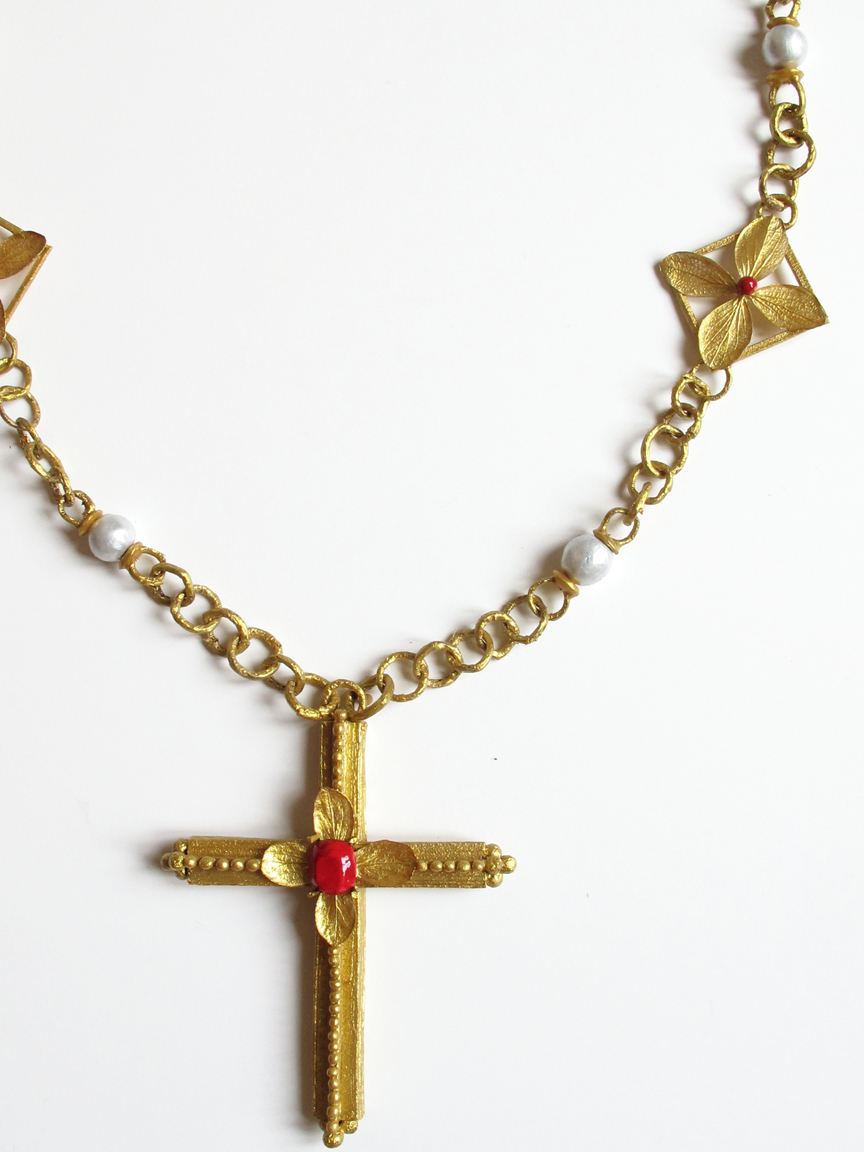
Quinevere Necklace made from dried plant material. Philadelphia Flower Show- by Mimi Favre 2013. 


Again this year I have made a piece of jewelry from dried plant material for the Philadelphia Flower Show. Keeping to the British show theme, "Brilliant", this Artistic Jewelry Class is called, “Quinevere”- Necklace. That is all the direction one is given. The challenge is to interpret the theme (points for that) as well as make a well-crafted piece that ‘looks’ as if it could be worn (lot's of points). Sounds easy, but every time I make one of these pieces I totally underestimate how much time it will take and work to the last possible minute. 

After reading a bit about the legendary Queen, I settled on a period piece that would reflect femininity and her Christian beliefs. A friend saw the components before I finished and said “it looks just like your jewelry!" I really love this piece and would welcome a chance to make it in real gold with a beautiful ruby!

The creative process is a combination of finding interesting organic plant material by shape or texture and thinking of ways it could be used. Collecting is an ongoing process and I do have several boxes of potential seed pods, nuts, leaves, stems, berries, etc. The spice cabinet or pantry aren't off limits either- I used mustard seeds and lentils on this necklace.

I was walking outside one windy day a few weeks ago and picked up a dried cluster of hydrangeas that had blown over from my neighbors house. I had been thinking of making a thick chain and cross and this was the inspiration I needed to flesh out the design. The petals as stations on the chain are a classic form in the decorative arts known as a quatrefoil which was used in the Medieval period. I added the holly berry 'pearls' to visually break the chain and make this a strong yet feminine piece, something a Queen might wear. 
Updated- read how to on PHS Online https://phsonline.org/blog/a-gem-of-a-class-looking-back-at-the-botanical-beauties-of-the-flower-sho
Components. Birch twig links, hydrangea Quatrefoil.
I made the cross, a very linear component, from verbena bonariensis (thank you Wendy). The links are made from green birch twigs, twisted onto chopsticks, left to dry, then cut into jump rings. Each one has to be glued closed. 
Quinevere Necklace- Cross and Quatrefoil.

Quinevere Necklace- verbena stem (squares), birch twig (links), holly berry 'pearls'. Mimi Favre. 2013

I was cleaning up the inevitable mess that I had made, a pile of discarded pieces, trial painted seeds, 'stone' settings not used, extra 'pearls' and thought, well, this picture says it all! I do paint ideas out first even thought the piece evolves organically.
Dried plant materials for Jewelry.

Quinevere Necklace. Hydrangea, beautyberry, verbena stems, holly berry, lentils and coriander.
Not shown, coffe bean (ruby).

Description card. MFavre 2013.


Saturday, March 3, 2012

A Lanai Hair Ornament-

Again,  I have created a botanical jewelry entry for The Philadelphia International Flower Show- March 4-11, 2012. This year's theme is Hawaii- Islands of Aloha. My entry is in the Artistic Jewelry Class titled  'Lanai Gathering- A Hair Ornament'. The entry must be made from plant material only such as seed pods, leaves, flower petals and nuts. Although the piece can actually be quite fragile, it must appear to be functional in scale and design. 
Concept Sketch. Favre
The first thing I do is research photos and the topic. Lanai is one of eight Hawaiian islands where tropical flowers and lush green foliage grow in abundance.  Hawaii is orchids, plumeria and exotic blooms. I decided my Hair Ornament would be a comb with fresh flowers. The next step is to find dry plant materials of various shapes and texture.
Boxwood leaves as Plumeria. Favre.
Dried Rhododendron pods- painted as flowers. Favre.

Chestnut and Onion skin Orchid. Favre.
A Chestnut with red onion skin and pieris leaves makes a perfect paphiopedilum orchid! Boxwood leaves become a plumeria flower. Dried Rhododendron pods split open to become an exotic bloom. The piece is slowly coming together.
Adding the gourd 'comb'.
A dried gourd has the perfect contour and material strength to be the comb. After cutting the rough outline I drew a pattern to be cut away. I also modified the comb design from my original sketch. In the background is a photo of an orchid that I used for reference.
Worktable. Pods, paint, nailpolish, etc.


Almost finished but lacking in fullness. Using my iPad app, Brushes, I drew over a photo of the piece in effort to visualize what I could add to make the piece stronger. More lavender flowers, more white Plumeria, and more 'green'. Also, need to bring more orange or yellow into the design. I used spray shellac on the gourd comb--I think it suggest tortoise shell which has a native Hawaiian look.
The Ingredients
 I am always on the look out for dried material to collect. Often these little treasures inspire jewelry designs. The Mesquite pod came from the grounds of the Tucson Convention Center during the AGTA Gemfair 2011!

Hair Ornament- Mimi Favre© 2012

The finished Hair Ornament for a Lanai Gathering.

I found Barbaraanne's Hair Comb Blog which is a very useful resource if you want to go deeper into the subject of Hair Ornaments.

Wednesday, June 29, 2011

Dogwood Ring

I opened an Internet shop called FavreBijoux on Etsy almost two years ago.  Etsy provides a template for photos and descriptions and facilitates transactions through PayPal. FavreBijoux is where I sell some of my production designs in both sterling silver and 18k gold along with a selection of one of a kind jewelry. The Internet has made it possible for artists like myself to connect with buyers anywhere in the world. Since opening I have shipped pieces to Europe, Canada and many states in the US. Today, every brand is developing a social presence and in many cases directly selling on their sites. Luxury products are selling online along with Fine Art.

Through the years I have made many wedding bands and other custom pieces to mark special occasions.  I have been privy to the engagement plans and intimate stories that inspire the jewelry and I am always honored that my clients share these personal messages with me. 

The original Dogwood ring was commissioned by a couple. She is a published author of books on horticulture and he is a master gardener and teacher of horticulture. Her love of the Dogwood flower, a native species in Pennsylvania, inspired the ring. My interest in botanical painting infused the project with the necessary detail required to sculpt the original wax.  I guess it should follow that this Dogwood ring is a sentimental favorite on Etsy and on several occasions it has become an engagement ring.
Dogwood Ring- 18k Gold. ©FavreBijoux on Etsy.
Dogwood Ring-18k gold. Original sketch ©Mimi Favre-FavreBijoux
Dogwood Ring- Sterling Silver. ©FavreBijoux-Mimi Favre


Saturday, March 5, 2011

Creative play

Entry with some of the material: acorns, Franklinia seed pod, sweet gum  tree pod, pine cone, eucalyptus leaf, wisteria seed, styrax seed. (not pictured:mustard seeds, peppercorn)

I am a collector of seedpods, leaves and pretty much all range of flora.  Often I find inspiration for my jewelry in the infinite shapes, forms and texture.  This year I was able to use some of my stash to create a piece of jewelry to enter in the Jewelry Class at The Philadelphia Flower Show.  The theme, Un Colleir pour la Reine (a necklace for a queen), is not intended to be worn however it is supposed to embody all the attributes of a real piece.  There isn’t a monetary award or notoriety attached to this, however if you win a blue ribbon you and your guest get to attend the big Luncheon for all the winners. If you live in Philly and/or you are into gardening, this show is a big deal. I do this for my own pleasure and to take a creative break even though this necklace took about twice as long as a real piece to make.

Art supplies, nail polish and dried pods take over the kitchen table. 

I have been designing and making jewelry for others and myself since attaining my BFA in Metals from Rochester Institute of Technology, back when it was The School for American Craftsmen. Finding inspiration for new work can be challenging at times and I have found that working in another medium infuses the creative spirit.  The design process is the same as if this were a commission however the only thing at stake this time is satisfying myself. And once completed, my necklace will be seen by thousands of visitors who slowly file past the lighted cases where mine and the other entries of this unique art form are displayed.

The pieces I didn't make.

Looking back over my sketches and holding the finished piece, I see changes that I could have made to make this a stronger design. If I were to make another I know what I would do differently the next time. This is the creative process at work. There is always something new to learn and put to use the next time.

A few things learned:
Admit that something isn’t working and don’t be afraid to start over.
Don’t get hung up using one element.
Step back and see the whole piece.
Rather than add, simplify- take something away.